


-
 Written By:
Alex Herrera
Written By:
Alex Herrera
-
 Edited By:
Phyllis Rodriguez, PMHNP-BC
Edited By:
Phyllis Rodriguez, PMHNP-BC
-
 Clinically Reviewed By:
Dr. Ash Bhatt, MD, MRO
Clinically Reviewed By:
Dr. Ash Bhatt, MD, MRO
She’s a senior partner at a top-tier law firm. She hasn’t missed a client call in seven years. Her performance reviews are flawless, and from the outside, her life looks like an aspirational template.
But at 2 a.m., when the deadlines stop and the silence starts, she reaches for the pill bottle, the one her doctor prescribed after a shoulder surgery eighteen months ago. What started as four days of post-op pain management has quietly, become something she can’t imagine her mornings without.
“Prescription drug dependence among high-performing professionals is one of the most underreported health crises in America, not because it’s rare, but because the people experiencing it are remarkably good at keeping it hidden, even from themselves.”
This article explores why driven, capable, high-achieving people are especially vulnerable to prescription drug dependence, and what the warning signs actually look like, and, most importantly, how to get effective, confidential help without sacrificing a career you’ve spent decades building.
Key Takeaways1. Dependence in high-performers starts with a legitimate prescription.Most executives and attorneys began with a genuine anxiety disorder or a real sleep problem. The medication worked, until it didn’t. Understanding this distinction is the first step toward approaching the situation without shame, and toward finding real solutions. 2. High-functioning dependence is specifically designed by circumstance.The same skills that make someone an exceptional professional become the apparatus that sustains denial. Still performing well is not evidence that nothing is wrong. It’s often evidence of how capable the person is at managing consequences. 3. Effective confidential treatment exists for professionals.Outpatient programs structured around professional schedules are the standard, where HIPAA protections apply. Most professionals complete treatment without their colleagues or employers ever knowing. The risk of getting help is far smaller than the risk of the dependence progressing untreated. |
What Is Fueling Substance Dependence Among Corporate Executives?
Prescription drug addiction in professionals rarely begins with recklessness. In most cases, it begins with a legitimate prescription and the reasonable expectation that the medication is temporary. What transforms short-term use into dependence is rarely a character flaw; it’s a convergence of neurological and cultural pressures that are uniquely intense in high-performance environments.
1. The Unrelenting Weight of Performance Pressure
Corporate executives and senior professionals operate under a kind of sustained pressure that most people never experience. The expectations aren’t just high, they’re permanent.
Chronic workplace stress and addiction are linked in a very specific way: prolonged, unmanaged stress dysregulates the brain’s reward and threat-response systems. Meanwhile, the brain begins seeking chemical relief. When a prescription medication provides that relief, even briefly, it creates a neurological template the brain desperately wants to repeat.
2. Sleep Disorders, Anxiety, and the Medication Cascade
Executive burnout and substance use are frequently connected through a third factor: sleep deprivation. Chronic stress leads to insomnia. Insomnia leads to a prescription for sleep aids or benzodiazepines. Those medications, taken over weeks rather than the recommended days, begin to alter sleep architecture.
Many professionals describe a “medication cascade”: one prescription leads to side effects, which are treated with another prescription, which leads to dependency, which generates anxiety, which is treated with yet another medication. The person isn’t misusing drugs in any traditional sense, they’re following their doctor’s instructions till they’ve become physically dependent.
3. The Cognitive Enhancement Culture Nobody Talks About
In many industries prescription stimulants are being used by people who want a competitive edge. The use of ADHD medications off-label has become so normalized in certain professional circles that refusing them can feel like refusing an advantage your peers are already taking.
This cognitive enhancement culture creates an environment where the line between optimization and dependence gets blurred until it disappears. The professional who started using Adderall to finish a quarterly report may, a year later, find that ordinary productivity is impossible without it.
___________________________________________________________________________________________________________
The Medications Most Often Involved, and Why They’re So Hard to Stop
Not all prescription drugs carry the same dependence risk, but three categories account for the vast majority of cases seen in executive and professional populations. Understanding the specific mechanism of each helps explain why stopping isn’t simply a matter of willpower.
1. Stimulants: When Productivity Becomes a Chemical Dependency
Adderall, Ritalin, Vyvanse, and similar ADHD medications work by increasing dopamine and norepinephrine in the brain, the neurochemicals associated with focus, motivation, and reward. For people with clinical ADHD, these medications can be genuinely transformative.
Prescription stimulant addiction in this population often develops gradually. In fact, the dependency goes beyond pharmacological and becomes deeply psychological: the belief that you simply cannot function, compete, or succeed without chemical assistance.
2. Benzodiazepines: The Anti-Anxiety Trap
Xanax, Klonopin, Valium, Ativan, these medications are prescribed for anxiety, panic disorders, insomnia, and acute stress responses.
Benzodiazepine dependence develops because, over time, the brain stops producing its own calming neurotransmitters and relies on the medication instead. The result is tolerance: the same dose produces less effect. And rebound anxiety makes it terrifying to stop without medical support.
For someone at a professional level, the idea of weathering rebound anxiety without medication can feel genuinely impossible. This is one of the most common reasons benzodiazepine dependence goes untreated in professional populations.
3. Opioid Painkillers: From Recovery Room to Dependence
Opioid painkiller misuse in professional populations often begins in the most ordinary way possible, and the transition from short-term pain management to dependence keeps on increasing.
Opioids are profoundly effective at managing physical and emotional pain. Stress, grief, isolation, and burnout all become quieter under their influence.
By the time the prescription runs out, the brain has adapted. Physical withdrawal, which includes flu-like symptoms, profound anxiety, insomnia, and deep bone pain, can begin within hours. For many executives, managing withdrawal while maintaining professional obligations feels impossible without help.
____________________________________________________________________________________________________________
Why High-Functioning Dependence Is So Difficult to See, Even for the Person Living It
Signs of addiction in executives are often obscured by achievement where the person still delivers results, they still show up from the outside, and often from the inside also, everything looks fine. The dependence is invisible because it’s been seamlessly integrated into one’s life.
“I knew something was wrong, but I kept telling myself I wasn’t an addict because I was still doing my job. I was still leading my team. Addicts don’t close multi-million dollar deals.” – a pattern we hear regularly in professional treatment settings
Several factors make hidden addiction symptoms in this population particularly persistent:
- High tolerance for discomfort: Executives are trained to push through and physical and psychological warning signs get reframed as temporary challenges to manage, not signals to heed.
- Rationalization as a cognitive skill: The same intelligence that makes someone an exceptional leader makes them exceptionally capable of constructing compelling arguments for why their situation is different, and why stopping isn’t practical right now.
- Privacy as a professional habit: High-level professionals develop sophisticated instincts around information that doesn’t disappear when the subject is personal.
- No obvious bottom: Without a crisis, there’s no external pressure point forcing the issue.
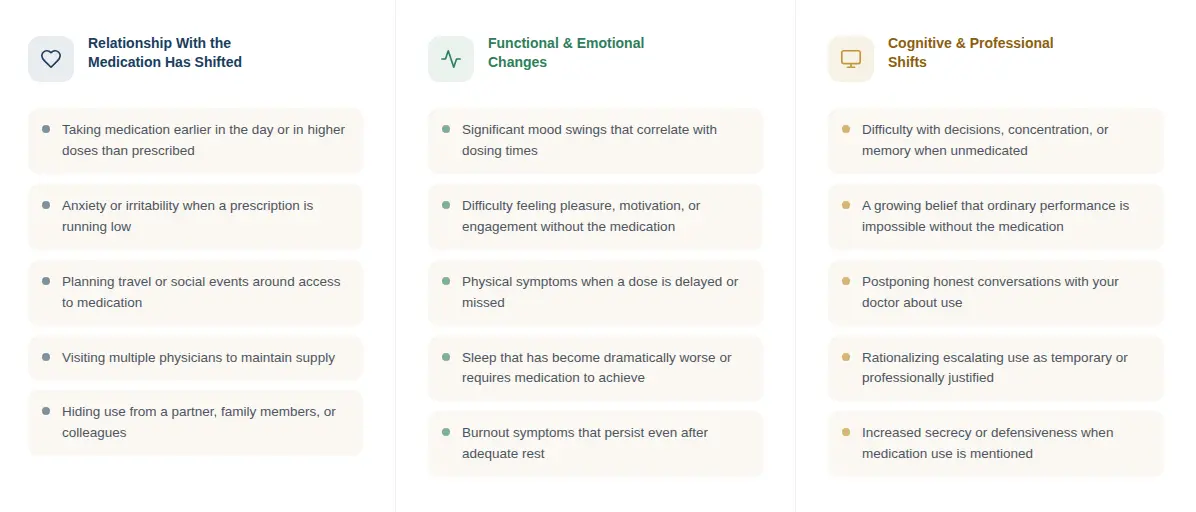
Warning Signs That Deserve Honest Attention
Early signs of dependence are often behavioural and emotional, long before they become physical. Recognizing them is a verdict; it’s a starting point.
The Reputation Question: Can Executives Seek Help Without Jeopardizing Everything?
This is the question that keeps more professionals stuck than any other. Here is what’s actually true about confidential addiction treatment for professionals in Los Angeles:
1. Medical Privacy Is Legally Protected
Treatment for addiction is medical care with proper HIPAA protections. A physician who treats you for prescription dependence cannot share that information with your employer, your licensing board, or anyone else without your explicit written consent. Private rehab in Los Angeles operates under the same protections as any other medical setting.
2. Treatment Can Be Structured Around Your Professional Life
Inpatient residential treatment isn’t the only path forward. In fact confidential addiction treatment in outpatient formats, including intensive outpatient programs allows people to continue meeting professional obligations while receiving evidence-based care.
Many professionals complete executive addiction treatment programs without their colleagues or employers ever being aware that they were in treatment. This is exercising the same medical privacy rights available to everyone.
3. The Risk of Not Getting Help Is Greater Than the Risk of Getting It
Untreated dependence tends to escalate, and slowly the same dose that used to comfort starts producing less effect, keeping you busy in organizing your day around the medication, and concealing starts taking more effort. The professional risks of untreated dependence are considerably higher than the (protected, private) risks of treatment.
____________________________________________________________________________________________________________
What Treatment Actually Looks Like for Professionals in Los Angeles
Los Angeles has developed a genuinely sophisticated ecosystem of professional-focused addiction treatment, one that reflects both the scale of the need and the specific requirements of a high-performing, privacy-conscious population.
1. Medically Supervised Detoxification
For anyone physically dependent on benzodiazepines or opioids, supervised medical detox is not a preference; it’s a safety necessity. Benzodiazepine withdrawal, in particular, can be medically dangerous without proper management. A supervised detox provides both physical safety and the professional structure to manage the process discreetly.
2. Medication-Assisted Treatment (MAT)
Medication-assisted treatment uses FDA-approved medications to stabilize brain chemistry while therapy and lifestyle work begin. MAT is evidence-based medicine with a strong clinical track record, and it’s available in outpatient formats that allow continued professional functioning.
3. Outpatient Rehab for Executives
Outpatient rehab for executives typically operates on a schedule that minimizes disruption to professional obligations. Intensive outpatient programs (IOP) generally involve 9–15 hours of structured therapy per week. Standard outpatient programs provide ongoing support at lower intensity as the recovery process matures.
These programs include individual therapy, group work with peers facing similar challenges, and specialized treatment for anxiety, sleep disorders, and burnout that frequently underlie professional dependence.
4. Luxury and Executive-Focused Residential Treatment
For professionals whose dependence has reached a point where outpatient care isn’t sufficient, or who prefer the comprehensive structure of residential treatment, luxury rehab in Los Angeles, offers high-privacy environments with appropriate amenities for high-net-worth individuals.
____________________________________________________________________________________________________________
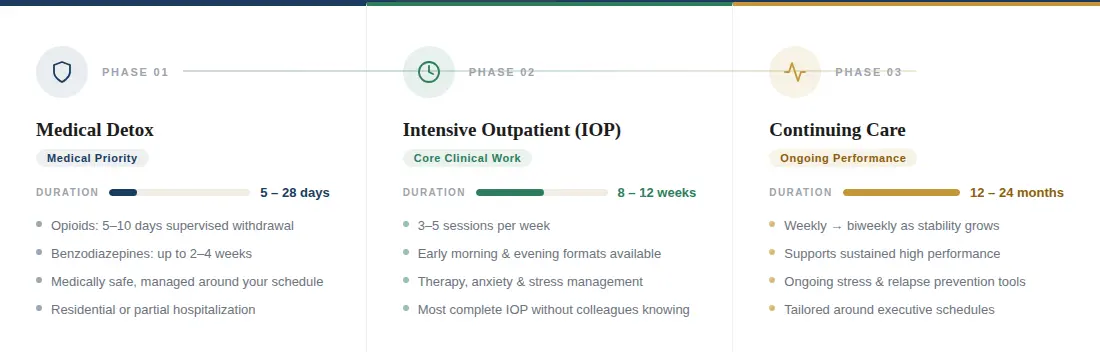
How Long Does Treatment Take? An Honest Timeline
Most professionals never have to disappear from their careers. Here’s what an honest timeline looks like.
Life After Treatment: What Returning to Work Actually Looks Like
The fear that addiction recovery for executives means a permanent change to their professional trajectory is common. The most consistent finding in professional recovery outcomes is this: people who receive appropriate, evidence-based treatment and build genuine recovery skills tend to become more effective professionally.
Maintaining Career During Treatment
Maintaining career during treatment is achievable for the majority of professionals in outpatient settings. The key variables are honest planning, boundary setting, and, where appropriate, selective disclosure to one trusted colleague or HR contact who can provide cover if needed.
For those in residential treatment, medical leave is a protected right under FMLA. A diagnosis that prompts leave for addiction treatment carries the same legal protections as any other medical condition.
Returning to Work After Rehab
Returning to work after rehab is, for most professionals, unremarkable from the outside. Colleagues don’t know why someone was away for medical leave.
What changes consistently is internal. The underlying anxiety that was being chemically managed gets appropriate treatment, and the sleep that was medication-dependent improves substantially with proper care.
Many executives describe returning to work after treatment as rediscovering capabilities they thought they’d lost.
The First Step Is a Private Conversation
If you’ve read this far, something in this article is probably resonating. That matters.
At Legacy Healing LA, we work specifically with professionals who need addiction treatment that respects the complexity of their lives, the confidentiality requirements, and the sophisticated questions about what treatment actually looks like in practice.
We’re here when you’re ready.
Call us at 8008084570